

Payroll integrity: The key to safeguarding your greatest asset — your people


Inherent in every employee's relationship with their employer is the expectation of being paid correctly. Sadly, employees themselves are often the ones who identify errors in payroll.
Many organisations are investing heavily in employee well-being benefits and career development initiatives to strengthen their employee value propositions while overlooking their staff's most fundamental priority – being paid correctly.
A survey conducted by LinkedIn found that more than 75% of job seekers research a company's reputation and employer brand before applying for a role 1. In today's highly competitive and transparent job market, payroll integrity isn't just about compliance, it is a strategic advantage that directly impacts employee engagement, loyalty, and your organisation's reputation.
In the current high cost- of- living environment, even a single wage error can undermine employee loyalty, especially if the company is posting record profits. Young workers 2 , migrants 3, 4 and minimum wage earners are disproportionately impacted by wage errors and are among those least likely to complain, due to the vulnerability of their positions.
Payroll errors come at a high price, both financially and reputationally. As a business leader, few things are worse than realising you have underpaid your staff. Yet, the payroll functions of many Australian organisations are underweight 5.
The list of organisations that have been impacted by wage scandals is staggering — large retailers, banks, mining companies, law firms, hotel groups, universities, and large not-for-profits — to name a few. Although wage remediations have become a focal point for the largest employers in Australia over the last few years, many others are yet to address this complex problem.
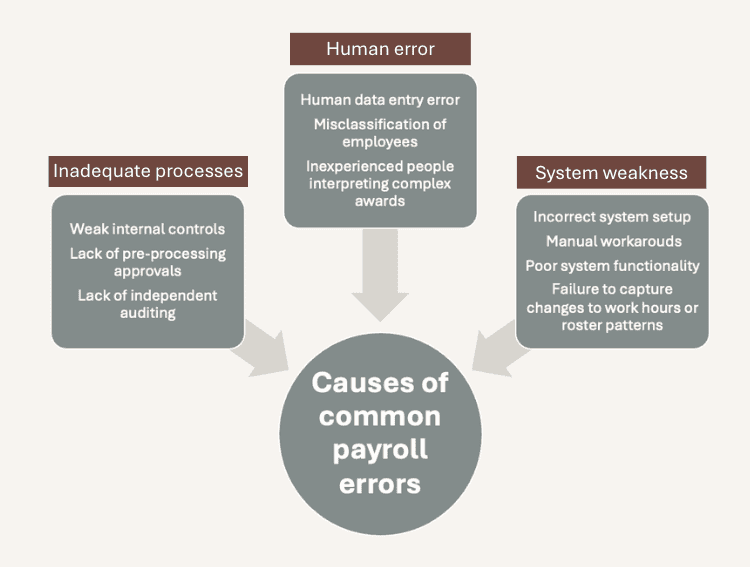
As part of your organisation's governance and risk management framework, payroll integrity must be prioritised to prevent legal, reputational, and operational risks. Responsibility for payroll integrity may sit with the CFO, Head of HR or the Legal function, however input is needed from all three, as well as IT, Operations and Internal Audit to get this right.
Recent workplace laws applicable from the start of 2025 have introduced criminal liability for intentional wage theft, putting a spotlight on payroll compliance.
Proactively performing a high-level review would be a good place to start to mitigate your organisation's risk. Getting it right is vital to safeguarding your organisation's most valuable asset — your people. It can also help you avoid a long and costly remediation program. Remediation programs take, on average, 1 – 4 years to complete — a very long period of disruption — with many stakeholders to manage including employees, unions, regulators, the Board and the media.
In future articles, we look at how senior executives and boards can assess their payroll compliance risk, and we look at strategic considerations for remediation programs.
References:
Linkedin Talent Solutions. ‘Employer Brand Statistics’. n.d. https://business.linkedin.com/content/dam/business/talent-solutions/global/en_us/c/pdfs/ultimate-list-of-employer-brand-stats.pdf.
‘Wage-Theft Is Rampant in Many Industries. Meet the Service Delivering Justice for Young Workers | Community Legal Centres NSW’, n.d. https://www.clcnsw.org.au/the-service-delivering-justice-young-workers.
Coates, Brendan, Trent Wiltshire, and Tyler Reysenbach. ‘Short-Changed: How to Stop the Exploitation of Migrant Workers in Australia’. Grattan Institution, May 2023. https://grattan.edu.au/wp-content/uploads/2023/05/Short-changed-How-to-stop-the-exploitation-of-migrant-workers-in-Australia.pdf.
Farbenblum, Bassina, and Laurie Berg. ‘International Students and Wage Theft in Australia’. SSRN Scholarly Paper. Rochester, NY, 30 June 2020. https://doi.org/10.2139/ssrn.3663837.
‘New Research Reveals Skill Shortages and Automation among the Biggest Pain Points for the Australian Payroll Sector’. ADP, 24 March 2025. https://au.adp.com/about-adp/press-centre/skill-shortages-and-automation-among-the-biggest-pain-points-for-the-australian-payroll-sector.aspx.
‘Australian workers back-paid $473 million’. Fair Work Ombudsman, 23 October 2024. https://www.fairwork.gov.au/newsroom/media-releases/2024-media-releases/october-2024/20241023-annual-report-2023-24-media-release .
‘The State of Australian Payroll’. Rippling, n.d. https://www.rippling.com/en-AU/resources/wage-theft-findings.
‘Employee Earnings and Hours, Australia, May 2023 | Australian Bureau of Statistics’, 21 February 2024. https://www.abs.gov.au/statistics/labour/earnings-and-working-conditions/employee-earnings-and-hours-australia/latest-release.
‘Trends in Federal Enterprise Bargaining’. Department of Employment and Workplace Relations, Australian Government, December 2024. https://www.dewr.gov.au/download/16955/trends-federal-enterprise-bargaining-december-quarter-2024/39851/trends-federal-enterprise-bargaining-december-quarter-2024/pdf.
‘List of Awards’. Fair Work Ombudsman, Australian Government, n.d. https://www.fairwork.gov.au/employment-conditions/awards/list-of-awards .
